Thursday, 3 March 2011

Ilkley Moor


Just to quickly share some photos I've taken of Ilkley Moor in the mist. I have a distinct fondness for Ilkley Moor, and it has a personal significance in my life as a common setting for dreams. It began to feature heavily in my dreams at the start of last year, and has been a place I have returned to at points of key change in my life in the past few years. Dream Ilkley moor and the real moor are indistinguishable, they blend together seamlessly and are each as unchartable as the other.


we happened upon this wolf sculpture howling over the edge of Windgate Nick on the way to the Doubler Stones.


Tuesday, 5 October 2010

Dobrudden

High over Shipley Glen, Dobdrudden hill is the highest point over Baildon moor and therefore stands in clear view of Ilkley moor. The look out over the Yorkshire landscape is beautiful, and one can see why our tribal ancestors chose these high places to bury their dead. Dobrudden is a funereal landscape, dotted with cairns and, as a later addition, medieval bell pits lurk in the long grass with deceivingly deep falls. Next to the wall of the caravan park, propped up uncomfortably against a low wall is a beautifully marked stone:


I often wonder if, like pictish stones, the cups reference a lineage or memorialise families. The way cups are grouped, linked together and circled again reminds me of family trees.


Wednesday, 22 September 2010

Leeds scheduled monuments project and Mardship Bow


I happened upon a page on the Leeds government website, which is quite hard to navigate to from the front page. It details the ancient scheduled monuments in the area with helpful maps on how to reach them, although some of them are out of date and the maps slightly unhelpful. I have been trying in the past six months to gradually work my way through the whole list, in a quest to deeper understand the landscape in which I have placed myself, and to try and shift my focus from the mundane distractions that are propelled to the forefront of our world view.

One of my dearest friends, Simon Bradley, shares my love of deviation from the set paths of modern living and has written a novel about the domination of the Yorkshire Omnibus Company over time in future, waterlogged Leeds. Simon and me have wandered the non-streets of Leeds and its surrounds and have had many an occasion to feel the narrowing of permitted thoroughways bearing down on us. It is my worry that life no longer revolves around the passing of folklore and mythology as a totem of belonging in whereever you are, but instead a clinical familiarity replaces it all, cold to the idiosyncracies of the land.

The ginnels and snickerways are overgrown now, deemed too dangerous although the tall grass suggests even the dark-hearted steer clear. Entire postcodes of Leeds are ghost-towns of neglect, unfashionable and undeveloped they lack the shopping malls and bus routes which renders them unpalatable to the masses.


I love leeds for its strangeness, the dark corners and impossibly confused architecture. Mary Bateman dragging her flayed skin cloak through the meanwood beck under Timble Bridge. I hope, through the story-telling of my friends and I, that these myths are living on and stay within the collective psyche of the city.

I will try and post up all of my explorations of the scheduled monuments (the grey stone and carving of cocidius are already up!) to this blog in the near future.

Sunday, 12 September 2010

The Witches Stone, Meanwood.


The trees drape the stars in love,
Each leaf sighs in longing, lorn but
Together in my eyes, set apart by the heavens.
Bent weeping, the stone turns away.

Whispering water down Meanwood Beck,
Flows through the stagnant heart of the city
Where witches meandered upstream for luck,
My secrets carried by the Aire to be lost, eventually, at sea.

Wednesday, 1 September 2010

Adel woods carving of Cocidius


Not far from Adel crag, we were, a year or so ago, shown a carving of the celtic god Cocidius. Recently both me and my friend Phil Legard have been searching for the carving to no avail, until today when I was wandering through the woods and noticed I was in a familiar grove.


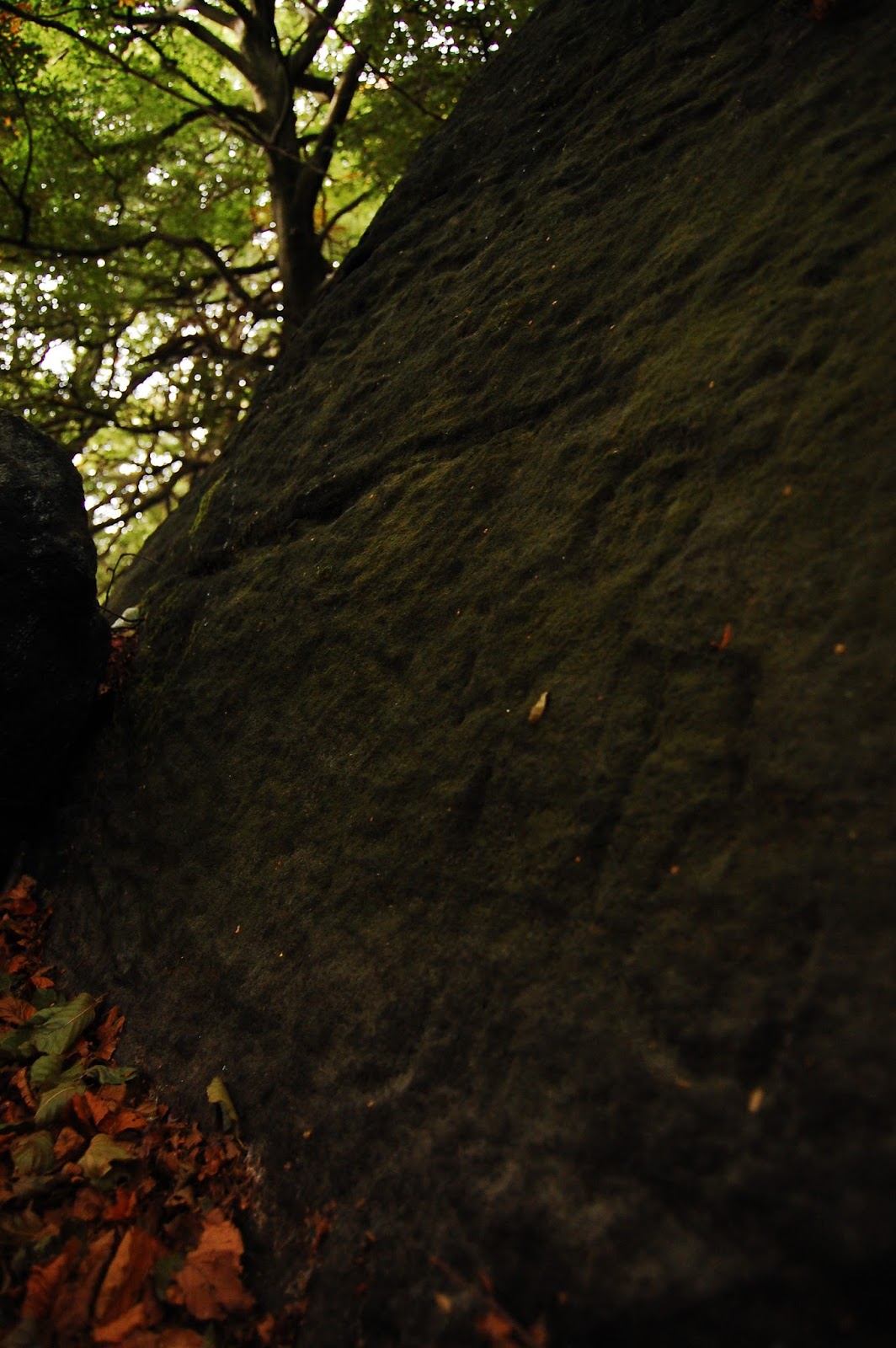
The carving lay here, the Red One sunk in mottled green rock. The tall beech trees give the clearing a cathedralesque quiet, the air is cool and the deep leaf litter slows your tread to a mindful pace. Jack-By-The-Hedge grows near and fills the air with heavy scent.


In the shrine of the war-god I am given courage to continue a difficult path. He is protector of both the hunter and the hunted, the tarot card 9, Adjustment, continually recalled at this spot.

A return visit a week later, darker still and the leaves have started to fall. My mind clear I picture a figure in the trees clad in red, who comes here before battle. What dark days lay ahead I do not know. My heart sways between being as heavy as a stone beneath a stream and being lighter than a feather.


Monday, 30 August 2010

Hell-hole, Bishop's wood.


I lives in a small village on the Staffordshire/Shropshire border from the age of 12. My mother had made friends with local gardeners, including an elderly woman named Joan, who had an interest in local folklore and customs. She told me that the woods opposite our house contained a gravestone that she'd never been able to locate but gave me rough directions as to where she thought it might be. The story she told me relating to the gravestone was that a local man in the last century had taken a second wife after his first had died and at her insistence he and she had drowned the two children in the river and buried the children in the woods.

I took the story for granted till some years later when I decided to make a renewed effort to find the gravestone. Based on what I discovered my guess is the woods she directed me to have receded over the many years past since the murders and the memorial is more likely in someone's back garden, or long since lost. The myth of the murderous step-mother also proved false. The children were slain by their own mother - whether this was a deliberate corruption as it was told to me or just the archetypal repetition by which mythologies become born over time, I do not know.

Ann Wycherley lived a poor, cold and violent life by all accounts. She was born in Market Drayton and lived there in the workhouse on Shropshire street. At 28 she was unwed and had two children, aged 2 and 4. She left the workhouse to elope with a lover that December and drowned her oldest child, a toddler, in Chipnall Mill pond, the side of the Bishop's woods known as Hell-hole, having walked the three miles out of Market Drayton, crossing the staffordshire/shropshire border.

 Bishop's wood is a lonely place, the sloping banks of trees seem to distill any available light to the barest of shade. The medieval glass houses would have been abandoned years before Ann stood with bloodied rock in hand but the ancient track-ways through the trees were the only route onward to Cheswardine. The snow would have been deep, the winters of 1835-38 were particularly harsh and unforgiving, the workhouse rags would not have afforded much warmth. Her inevitable capture some 8 miles further west at Baldwin's gate, enroute to Newcastle under Lyme, gave no mention of her companion although much was made of the fact she was simple and coerced into slaughtering her child by this shadowy figure.

In March she was tried by Judge Baron Gurney where she claimed to be pregnant to delay her execution but as it became clear she wasn't with child she was hung outside Stafford Gaol, May 5th 1838.

I spent much of my teenage years looking for the memorial, apparently a stone erected in the memory of the child at the spot where she left her in the snow that day, but I never found it. Ann Wycherley was buried in the gaol grounds at Stafford, the infant river Sow flows down from Bishop's wood to where she lays.

Wednesday, 28 July 2010

The Grey Stone ring carvings, Harewood and Almscliffe Crag


The grey stone erratic boulder overlooking Harewood house and across to Almscliffe, stone 399 on the Boughey and Vickerman survey. Its very easy to locate for rock art, a bridleway through some imposing gates opposite a turning to Wike on the A61 road lead up to New Bridge over the river, the grey stone is on the hill 340m SE in Grey Stone Pasture (appropriately!) on the left just before you reach the woods and bridge, theres a large oak tree on the hill behind it too. The concentric circles of the carving face west towards armscliffe, the natural rock boulder mirroring the silhouette of the outcrop in minature form, the midwinter full moon of the bronze age would have set behind Almscliffe viewed from this point. We visited for the winter solstice sunrise of 2009 and the glow over the valley was beautiful.


The 7 circles without inner cup remind me of some circle lightning I saw as a child, ever decreasing mirroring without end. We elaborately disguise our feelings and thoughts to give ourselves the impression of change but ultimately the patterns remain the same. Microcosm of life on a microcosm of the focus of this area. Almscliffe draws the eye from a full circle around it, from all points you notice its mushrooming intrusion on the landscape.


I've been particuarly interested in Paul Bennett's findings about Almscliffe's Faerie's Parlour, the existence of which had also been confirmed to me by a climber friend. Apparently its a very small enclosed tunnel which you can crawl so far comfortably but then becomes extremely claustrophobic. This tunnel supposedly leads from Almscliffe to emerge out from under the bridge I mentioned below the grey stone at Harewood. The Northen Caves entry on the cave however details an exploration by Royal Park middle school in the 70's.

The tunnel has been an obsession now for months! We have explored it to at least a depth of 50 metres, but time and fear has kept us from our goal.


Me and my friends have created an E-book related to Almscliffe, and music to accompany the text.

http://almias.org.uk/

I'd like to think this is a project which will grow with time, as we didnt cover everything we discovered due to time limitations. Specifically the connections between almscliffe and the grey stone, which are referred to in the local folklore of Rombold the giant. He lived in Ilkley, on the moor, and frequently argued with his giantess wife. One arguement resulted in a chod of rock being thrown from Ilkley at the retreating giant, and where it landed it formed Almscliffe and a smaller piece, the Grey stone.