Wednesday, 22 September 2010

Leeds scheduled monuments project and Mardship Bow


I happened upon a page on the Leeds government website, which is quite hard to navigate to from the front page. It details the ancient scheduled monuments in the area with helpful maps on how to reach them, although some of them are out of date and the maps slightly unhelpful. I have been trying in the past six months to gradually work my way through the whole list, in a quest to deeper understand the landscape in which I have placed myself, and to try and shift my focus from the mundane distractions that are propelled to the forefront of our world view.

One of my dearest friends, Simon Bradley, shares my love of deviation from the set paths of modern living and has written a novel about the domination of the Yorkshire Omnibus Company over time in future, waterlogged Leeds. Simon and me have wandered the non-streets of Leeds and its surrounds and have had many an occasion to feel the narrowing of permitted thoroughways bearing down on us. It is my worry that life no longer revolves around the passing of folklore and mythology as a totem of belonging in whereever you are, but instead a clinical familiarity replaces it all, cold to the idiosyncracies of the land.

The ginnels and snickerways are overgrown now, deemed too dangerous although the tall grass suggests even the dark-hearted steer clear. Entire postcodes of Leeds are ghost-towns of neglect, unfashionable and undeveloped they lack the shopping malls and bus routes which renders them unpalatable to the masses.


I love leeds for its strangeness, the dark corners and impossibly confused architecture. Mary Bateman dragging her flayed skin cloak through the meanwood beck under Timble Bridge. I hope, through the story-telling of my friends and I, that these myths are living on and stay within the collective psyche of the city.

I will try and post up all of my explorations of the scheduled monuments (the grey stone and carving of cocidius are already up!) to this blog in the near future.

Sunday, 12 September 2010

The Witches Stone, Meanwood.


The trees drape the stars in love,
Each leaf sighs in longing, lorn but
Together in my eyes, set apart by the heavens.
Bent weeping, the stone turns away.

Whispering water down Meanwood Beck,
Flows through the stagnant heart of the city
Where witches meandered upstream for luck,
My secrets carried by the Aire to be lost, eventually, at sea.

Wednesday, 1 September 2010

Adel woods carving of Cocidius


Not far from Adel crag, we were, a year or so ago, shown a carving of the celtic god Cocidius. Recently both me and my friend Phil Legard have been searching for the carving to no avail, until today when I was wandering through the woods and noticed I was in a familiar grove.


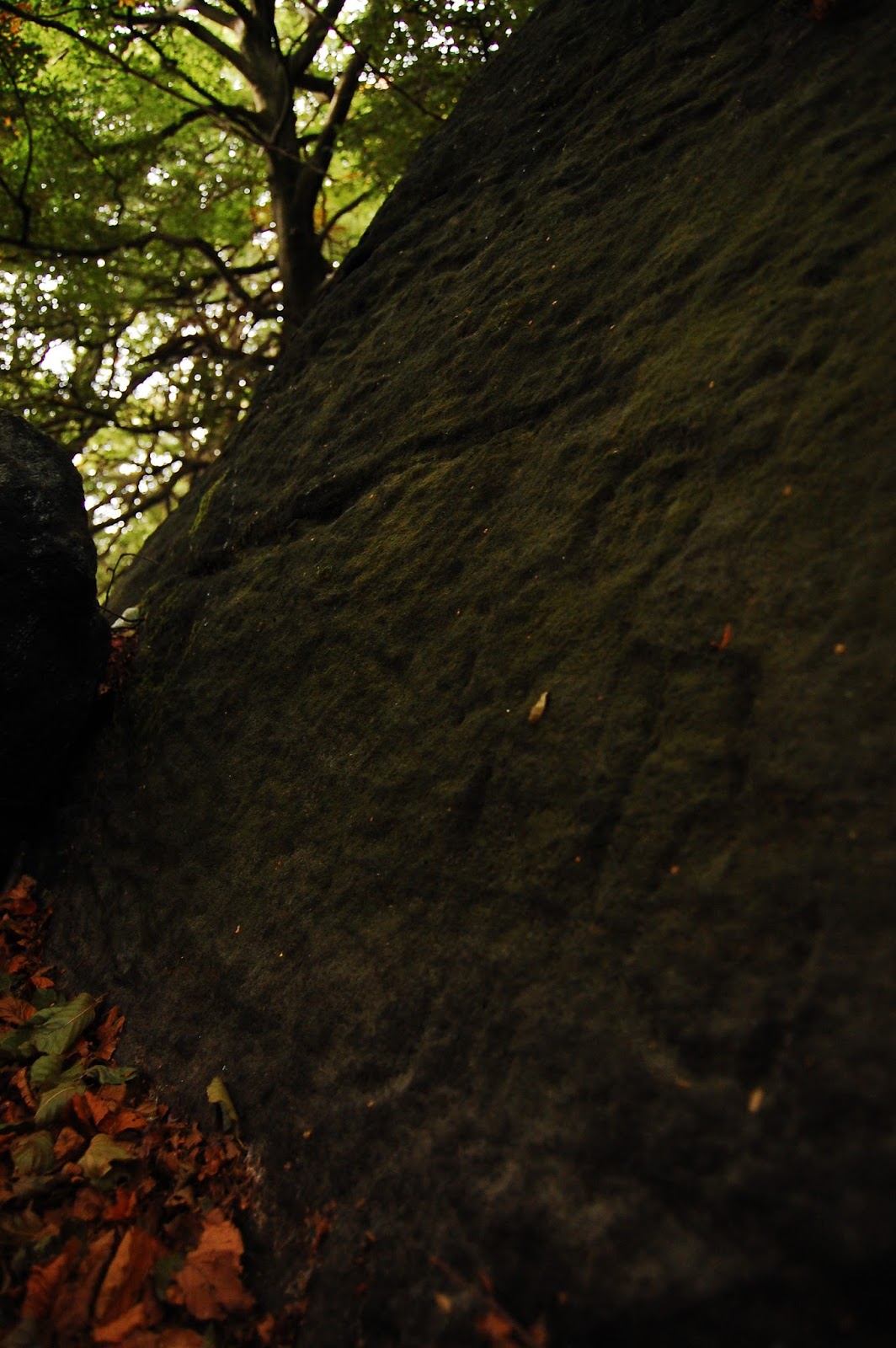
The carving lay here, the Red One sunk in mottled green rock. The tall beech trees give the clearing a cathedralesque quiet, the air is cool and the deep leaf litter slows your tread to a mindful pace. Jack-By-The-Hedge grows near and fills the air with heavy scent.


In the shrine of the war-god I am given courage to continue a difficult path. He is protector of both the hunter and the hunted, the tarot card 9, Adjustment, continually recalled at this spot.

A return visit a week later, darker still and the leaves have started to fall. My mind clear I picture a figure in the trees clad in red, who comes here before battle. What dark days lay ahead I do not know. My heart sways between being as heavy as a stone beneath a stream and being lighter than a feather.


Monday, 30 August 2010

Hell-hole, Bishop's wood.


I lives in a small village on the Staffordshire/Shropshire border from the age of 12. My mother had made friends with local gardeners, including an elderly woman named Joan, who had an interest in local folklore and customs. She told me that the woods opposite our house contained a gravestone that she'd never been able to locate but gave me rough directions as to where she thought it might be. The story she told me relating to the gravestone was that a local man in the last century had taken a second wife after his first had died and at her insistence he and she had drowned the two children in the river and buried the children in the woods.

I took the story for granted till some years later when I decided to make a renewed effort to find the gravestone. Based on what I discovered my guess is the woods she directed me to have receded over the many years past since the murders and the memorial is more likely in someone's back garden, or long since lost. The myth of the murderous step-mother also proved false. The children were slain by their own mother - whether this was a deliberate corruption as it was told to me or just the archetypal repetition by which mythologies become born over time, I do not know.

Ann Wycherley lived a poor, cold and violent life by all accounts. She was born in Market Drayton and lived there in the workhouse on Shropshire street. At 28 she was unwed and had two children, aged 2 and 4. She left the workhouse to elope with a lover that December and drowned her oldest child, a toddler, in Chipnall Mill pond, the side of the Bishop's woods known as Hell-hole, having walked the three miles out of Market Drayton, crossing the staffordshire/shropshire border.

 Bishop's wood is a lonely place, the sloping banks of trees seem to distill any available light to the barest of shade. The medieval glass houses would have been abandoned years before Ann stood with bloodied rock in hand but the ancient track-ways through the trees were the only route onward to Cheswardine. The snow would have been deep, the winters of 1835-38 were particularly harsh and unforgiving, the workhouse rags would not have afforded much warmth. Her inevitable capture some 8 miles further west at Baldwin's gate, enroute to Newcastle under Lyme, gave no mention of her companion although much was made of the fact she was simple and coerced into slaughtering her child by this shadowy figure.

In March she was tried by Judge Baron Gurney where she claimed to be pregnant to delay her execution but as it became clear she wasn't with child she was hung outside Stafford Gaol, May 5th 1838.

I spent much of my teenage years looking for the memorial, apparently a stone erected in the memory of the child at the spot where she left her in the snow that day, but I never found it. Ann Wycherley was buried in the gaol grounds at Stafford, the infant river Sow flows down from Bishop's wood to where she lays.

Wednesday, 28 July 2010

The Grey Stone ring carvings, Harewood and Almscliffe Crag


The grey stone erratic boulder overlooking Harewood house and across to Almscliffe, stone 399 on the Boughey and Vickerman survey. Its very easy to locate for rock art, a bridleway through some imposing gates opposite a turning to Wike on the A61 road lead up to New Bridge over the river, the grey stone is on the hill 340m SE in Grey Stone Pasture (appropriately!) on the left just before you reach the woods and bridge, theres a large oak tree on the hill behind it too. The concentric circles of the carving face west towards armscliffe, the natural rock boulder mirroring the silhouette of the outcrop in minature form, the midwinter full moon of the bronze age would have set behind Almscliffe viewed from this point. We visited for the winter solstice sunrise of 2009 and the glow over the valley was beautiful.


The 7 circles without inner cup remind me of some circle lightning I saw as a child, ever decreasing mirroring without end. We elaborately disguise our feelings and thoughts to give ourselves the impression of change but ultimately the patterns remain the same. Microcosm of life on a microcosm of the focus of this area. Almscliffe draws the eye from a full circle around it, from all points you notice its mushrooming intrusion on the landscape.


I've been particuarly interested in Paul Bennett's findings about Almscliffe's Faerie's Parlour, the existence of which had also been confirmed to me by a climber friend. Apparently its a very small enclosed tunnel which you can crawl so far comfortably but then becomes extremely claustrophobic. This tunnel supposedly leads from Almscliffe to emerge out from under the bridge I mentioned below the grey stone at Harewood. The Northen Caves entry on the cave however details an exploration by Royal Park middle school in the 70's.

The tunnel has been an obsession now for months! We have explored it to at least a depth of 50 metres, but time and fear has kept us from our goal.


Me and my friends have created an E-book related to Almscliffe, and music to accompany the text.

http://almias.org.uk/

I'd like to think this is a project which will grow with time, as we didnt cover everything we discovered due to time limitations. Specifically the connections between almscliffe and the grey stone, which are referred to in the local folklore of Rombold the giant. He lived in Ilkley, on the moor, and frequently argued with his giantess wife. One arguement resulted in a chod of rock being thrown from Ilkley at the retreating giant, and where it landed it formed Almscliffe and a smaller piece, the Grey stone.


Tuesday, 4 May 2010

Labyrinths


The maze-like corridor systems of asylums for the mentally ill remind me of the twists and angles of a labyrinth, ultimately the patients entered through the same grandiose administration blocks, with the repeated clock towers' eye recording the moment, and mostly they stayed there till death, living out the same daily patterns, a series of monotonous movements designed to instill a sense of quiet unquestioning confusion.


Once at High Royds asylum, I climbed through a broken window while my friend waited outside. As I stood inside the corridor waiting for her to step through the sash window slid upwards of its own accord. We carried on regardless, she stepped through the portal as if nothing had happened, although a fear lay inside me of what would happen if the sash flew back down with some kind of supernatural force.


I have wandered those corridors for many hours looking for a mirror that shows me who I really am. The way we search in each other's souls for a deeper truth than we see in our own, a sentence more poignant for its distance from our own hand. Those we have lost we immortalise in moments that are tied to these places. Upon returning to the ever-decreasing maze of passageways left at the hospital I recalled conversations, episodes of time which replay in my mind as I walked through thorn-littered hallways. The ghosts lost in a dream High Royds are very familiar, the place I know in my sleep has windows which close behind us and never let us leave, trapped together in a comic tableaux of our own creation. We left a stain on the slab which cannot be washed clean.


Monday, 22 March 2010

The Chevin over Otley - Cups, Crags and Bulls

With the joy of almost completely mutually appreciative company we bore on high upon the Chevin. The wind up here is always high to a breathless degree, whipping spirits up despite the fact you nearly always seem to be walking against the blow. The cloud broke often to give us heady spring rays and the view over Otley was so perfectly presented you could pick out shop fronts, possibly the Prince tribute shop if you are in the right mood. We decided to firstly locate Knotties stone, the best known megalithic feature upon the chevin. The track east towards the quarry on suprise view leads alongside the Yorkgate road, just as you reach a point parallel with plantations of trees on both sides of the path you should see a fairly wide stone with a large carving on your left.


Knotties stone has a striking similarity to the Grey Stone at Harewood. The rings and four central cups with a channel drawn out over to the east of the rise of Almscliffe did seem to me to be a deliberate directive act.


Image from Rombolds Way by E.T. Cowling


I can imagine beltane fires being lit here, maybe on beacon house farm, and on the horizon at almscliffe crag and in turn from there north east at harewood. The stone itself was low and unmovable, heavily worn and warm from the sun. We all bowed in turn around it to take angled shots of the shallow grooves and marvelled at the view from the spot. I guess this would be called the 'common' cup and ring as it follows a similar pattern to many in the UK and certainly the majority of local petroglyphs, but I tried on the spot to find some kind of physical relevance to the locality. The classic question in regards to cup and rings, and therefore what you decide when on location what to look for, is undoubtably as to whether they are ornament or amulet, as probed by H. J. Dukinfield Astley in Cup-and Ring-Markings: Their Origin and Significance and many others since . My feeling (greatly influenced by the writings of Alexander Thom and Aubrey Burl) has been that they had a double use as tools to determine astronomical events which had a great significance to the religion of a people who depended upon planning their survival through winters, and also coming together at times of fertility such as May day. If Aubrey Burls interpretation of the evidence from funereal customs in the Rites of the Gods is accurate, the communication between local settlements in times of often dire need were vital for their survival. Therefore beacon points like Almscliffe, the Chevin and Harewood were too essential to the communities and these carvings could have some use in such customs, which I think probably explains the remote hilly locations a lot of cup and rings exist in.


Taking into account the physical design of the carving, four cups within a set of 5 concentric rings with a strong line drawn from the centre outwards pointing north east. I wanted to consider the ornamental possibilities of the stone, because although our prehistoric forebearers must have been extremely hardy, practical people in order to survive, the poetry and artistic slant that many megalithic remains possess is undeniable: just look at the carvings at Bryn Celli Du in Anglesey or Newgrange in Ireland, and the poetic acts discovered in funereal rites at places like the barrow at Aldro in the Yorkshire wolds where an arrow head was found deliberately broken and placed pointing directly at the smashed skull of a infant burial. I was interested by the ideas put forth by Gyrus on the dreamflesh blog that suggested the patterns found in rock carvings related to shamanic practices. The river Wharfe lies directly below snaking through the landscape quite spectacularly, truly Gyrus' Verbeia serpent goddess in form. The concept of visionary experiences at these points seems entirely feasible, the altitude definitely lends itself to altered mindscapes, the wind high on the hill creating a kind of roaring isolation of sound. I thought the sites of some carvings could bear comparison to the Taoist shrines atop Mount Tai, supposedly channeling some kind of inherent power from the mountain itself but also its location offering the solitude, peace and altered air pressure to achieve a certain state of mind. Dobrudden necropolis in nearby Baildon moor was also home to a beacon fire, is high up on the landscape and obviously had sacred significance to the people buried there, and again we can see heavy concentrations of cup and rings nearby. The vortex like circles on knotties stone could very well be symbolic of some act of visionary questing, the carving possibly traced in some act of ritual devotion as a labyrinth is. One cannot help but trace these circles on first inspection, it is a compulsion to follow the curve and spiral on its path.


Southward we then headed down the footpath behind the Royalty pub. There was some slight confusion with directions but you can see the Bull stone from the pub if you look carefully from the added height of the style, and from there its just straight across two fields and hopefully avoiding whatever frisky cattle lays in wait that day. The Bull stone, so called because of a whetstone reference, a bull baiting past or a roman fertility remenant from the old road that runs along side it. Eitherway an impressive monolith, deeply weathered from a long upright stance. Just shy of six foot high and with a few possible companions hiding in the dry stone walls nearby. We hesitated to run across the field to meet the stone because of various animal guards, and as I walked up to the stone some horses were bucking alongside the fence a few feet away. The stone stands in private farmland so its probably better to skip along to the farm and ask permission, we didnt for our trip but in hindsight it seems polite with animals in the field. A mysterious stone, not on any of our OS maps but seems to be known locally at least. The rites of spring are often connected to the ancient Mithraic practice of sacrificing a bull, and it seems a strong coincidence to have the Mayday beacon gathering spot atop the chevin so convieniently positioned next to the bull stone, possible location of a bovine sacrifice. Also its interesting to consider that one of the more prominant stones in the Dobrudden necropolis has a carving which has been likened to the constallation of pleiades, which is in the zodiac sign of Taurus, the bull. These Beltane fires seem obvious meeting points at boundary lines between seperate communities where spring festivities and rituals could occur. Almscliffe, the Chevin and Dobrudden on Bailden moor all directly overlook ancient boundary lines, and Harewood, the Township Boundary.


we departed along the path of the roman road, realising that the stone was indeed visible from the road and looked much taller from this perspective than standing next to it. I was struck with the idea of arranging to light small fires at the Greystone, Almscliffe and Chevin on Beltane eve to see the effect.