Saturday, 23 March 2013

Wayzgoose Border Morris Tour of the Borders

Wayzgoose are the Border Morris side most local to me, hailing from fair Otley, they are one of the sides that dance up the sun with Briggate Morris on the Chevin at May day. I have a special fondness for them as I have made good friends with a few of the side and of course, they dance very well!


One of their recent undertakings has been to organise a tour of dancing: taking traditional Border Morris dances back to the named locations. I have always found the idea of specific dances for a location interesting, especially if it seems to incorporate geographical curiosities and idiosyncrasies into the actual steps of the dance.

One of Briggate's North West dances, Chevin Shindig, is the first we perform when dancing up the sun on the Chevin hill over Otley, and usually the first we perform at any dance out. The figures are performed by sets of three, the chorus includes circling anticlockwise around each dancer in turn, who simultaneously circle themselves clockwise.


I like to associate the spiraling motions of the dance with the sun we hope to rise, aptly for a May day dance it seems to be signifying the turning of the year, and of course the lovely cup and ring rock that sits atop the Chevin. 

We dance a fair few dances which have names evoking specific locations in and around Leeds, Horsforth Fours, Kirkstall Garland, Chandos Five all relate to places where the dances were created. While these dances were created relatively recently for our side, most of the dances Wayzgoose will be performing on their tour have a more authentic pedigree, some being collected in the 19th century and potentially being forms of much earlier dances. The side have learnt 7 new dances since Christmas in order to perform on the tour, no small effort on their part.


I had a quick chat with Stewart Ellinson from Wayzgoose about the tour earlier today, here is some of our discussion;


Layla -  How old are the dances you will be dancing?

Stewart - We don't really know how old the dances are. Some were collected in the earlier part of the 20th century whilst others are mentioned in the 19th. Unlike Cotswold Morris, there seems to have been very little active collecting of Border dances during the period when they might have been properly remembered, and people like Cecil Sharp thought that they were corrupted versions of earlier, purer dances.


 L -Do the dances themselves have any symbolic references to the geographical features of the locations they represent?

 S- They don't have any particular relationship to their locations in structural terms - the dances that survive are quite fragmentary and there may have been others in earlier times. What we do know is that actually, border dances seem to have been done around Christmas by farm workers and in that sense the tradition is similar to Molly dancing and "plough stotting" from East Yorkshire. It was a way of the unemployed making a few extra quid in the winter (which might explain the blacking up). As an aside, I think it was a similar reason that the whole Cotswold revival started: Cecil Sharpe was somewhere for Christmas and he saw (I think) the Headington quarry men dancing - they didn't do it normally, but thought they'd try a few dances for boxing day as cash was short.


 L - What do you think is the importance of taking the dances back to their original locations?

 S - Why are we doing it? IMHO, these are the things that underlie what we do more widely. Some of the dances that we are doing are very simple and are almost never seen "out". Things like Bromsberrow Heath and Upton Snodsbury are simply line reels and sticking, so very few sides actually bother to dance them out. I think we need to know and do these things firstly as they are the basis of everything else we do and secondly because they need / should / deserve to have an existence, and not be simply lines on a page. As far as I know, Bromsberrow Heath dance hasn't been done in Bromsberrow Heath village for ten years. It needs to be, and we need to go and do it so that we can truly call ourselves Border dancers.


View The Border dance locations in a larger map

L- Yes! Very much in agreement, this seems like an honorable cause to me.

 S- For the side, I think we need to have a project every year, so we don't get stale. This year it's this, next year I want to do 20 different dances, one at each of the 20 different pubs in Otley. There's also talk of us going to the Green Man festival, which would take us into the world of "Rawk" festivals. Otherwise, we do the same things with minor variations, year in, year out. I've also always wanted to take the side to Glastonbury. The problem with doing folk festivals is that you're gigging to the converted, this would be a different animal. However, to do that we need a bigger, punchier band, so expanding the music side is also a priority at the moment.

L- Mm, after seeing photos of the Wild Hunt dancing at Stonehenge and Avebury - that is the holy grail of dancing in my eyes!

S - I'm not so convinced about taking the side to ancient monuments, because that's making a bogus connection between the ancient past and Victorian folk culture, I just like the idea of taking the side to a new audience and seeing how we work with people who aren't just here for the folk.

 L - But people have a modern, contemporary connection to ancient monuments that is independent of any Victorian influence, I like to think that any experience of ancient monuments is what you make it, as well as the historical connection being a factor. Take dancing the sun up, it doesn't matter to me how long Briggate have been doing it there, whether the act is a Victorian idea of what a pagan tradition might be, or indeed if it is a truly ancient thing, it's the symbolism of the act itself now from an entirely fresh perspective.

 S - I'd agree it's what you make it, but I'm skeptical about a pseudo-pagan movement that romanticises the past and attaches collective meanings to things that were, for the makers, very diverse. We're doing it in the now, for the now but from the past.

L - I think some people might say Morris dancing is a pseudo-pagan movement that romanticises the past though!

 S - Ab-so-lute-ly, It's all made up by people in the 20th century and it's pagan if you want it to be. If you buy me a beer, it's pagan, if you buy me another one, it's folk culture. It's anything you want it to be because it's our construction of the past.


Should you be in the Malvern Hills area and fancy watching some excellent Border dancing, the tour details are as follows:

 Saturday 30th march 2013


Upton upon severn 10.00 - 10.30 

The Waterfront Bromsberrow heath 11.00- 11.30 

The Post office Evesham 12.15 -12.45 

The Market Place Pershore 1.00-2.30 

The Angel Inn and Posting House Peopleton 2.45- 3.30 

The Crown Inn White ladies Aston 3.45-4.00 

St. John the Baptist church Upton Snodsbury 4.15 till we drop The Oak,
Worcester Road, Upton Snodsbury


Sunday 31st march 2013


 Dilwyn 12.00-1.00 The Crown, Dilwyn, HR4 8HL

 Brimfield1.30-2.00 The Roebuck, Brimfield, Ludlow, SY8 4NE

 Much Wenlock 3.00-4.00? The square (probably!)

You can also get more information and updates via the Wayzgoose tour Facebook event page.

Big thanks to Stewart for taking the time to answer my questions and good luck to the side for their weekend of dancing!

Thursday, 21 February 2013

Towton Battlefield

A field 
 After battle utters its own sound 
Which is like nothing on earth, but is earth.

Funeral Music by Geoffrey Hill


The snow came a few hours after we left Towton battlefield, the skies promised downfall all day. The battle, on 29 March 146, was fought in equally bitterly cold conditions, with the driving snow assisting towards a Yorkist victory against the odds. The landscape is beautifully evocative as, unlike other battlefields from the War of the Roses such as the rather featureless plains of Blore Heath, the Towton geography defined the way battle was fought and won.


We started our walk near the Crooked Billet pub, walking over the field to Lead Church, near where the Yorkist encampment would have been. The church dates back to the 14th c, with monuments to crusading knights inside. 


The door has beautiful lettering detailing the restoration work on the church over the years, a group of ramblers were the catalyst for the 1930's restoration work and the church remains in lovely condition today. 


Behind the church the ground shows the lumpy evidence of an accompanying medieval settlement, and the footpath leads through this up onto a farm track. I found a small piece of broken pottery on the side of a ploughed field but I don't have any idea of it's age! 


Crossing back over the Cock Beck onto the road, we continued up to the commemorative cross, near where the Lancastrian lines were formed. The Dacre cross is probably an earlier roadside monument, now restored and engraved with the date of the battle. 


Walking down the new battlefield trail towards the Cock Beck the view overlooks Bloody Meadow, where the burial mounds are said to flower with the Towton rose. 


The Lancastrian army marched up from Towton, ending up with the valley of the Cock Beck to their right. 


The wind was against them and hindered their archers, the Yorkist arrows flying with the wind to reach their targets whilst the Lancastrian arrows fell short. The battle was alleged to have been fought for 8 hours, with huge casulties on both sides, and by late afternoon seeming to be swinging in the Lancastrians' favor. 


 the Duke of Norfolk and his army arrive to support the Yorkist side, having traveled up the Great North road. The Lancastrians flee down to the slope to the beck where a bridge allowed them crossing from the Yorkist army who now gave chase. The bridge gave way under the weight of the men and many drowned, others using the bodies of their companions as a means to cross the river. The location is now known as the Bridge of Bodies, even those who managed to cross were hunted down as far away as York and slaughtered. 


Figures on the exact death toll vary but it is estimated that around 28,000 men died at Towton that day, an immense number given the entire population of England at the time was around 2,100,000 people. Whole villages were decimated, the adult male populations now gone. Towton was a grave-site with huge mass graves leaving the ground unfit for ploughing. Richard III, in the wake of his victory, exhumed the bodies in 1484 and attempted to redress some of the damage by giving the men proper burials and erecting a chapel at the site. Richard said at the time:

‘Their bodies were notoriously left on the field....and in other places nearby, thoroughly outside the ecclesiastical burial-place in these hollows.Whereupon we, on account of affection, contriving the burial of these deceased men of this sort, caused the bones of these same men to be exhumed and left for an ecclesiastical burial in these coming months, partly in the parish church of Saxton in the said county of York and in the cemetery of the said place and partly in the chapel of Towton....and the surroundings of this very place.’

The chapel was never finished, Richard III was killed at the battle of Bosworth in 1485. 

~

Our visit to Towton coincided, quite by accident, with the discovery of Richard III's remains. The archaeological impartiality of the Leicester dig seemed to be tainted due to the dig being partly funded by amateur historians with an earnest desire to clear the name of the much vilified king. While many myths had been propagated by the successive Tudors, ultimately, judgement of the character of Richard III seems to hang on the rather extreme probability that he murdered his two nephews in order to become king himself.

The battlefield, alongside the many other relics of the 30 year long War of the Roses, remains as a testament to the ultimately callous nature of the incestuous family of rulers who forced men to fight for their tenuous blood-right. 


Tuesday, 12 February 2013

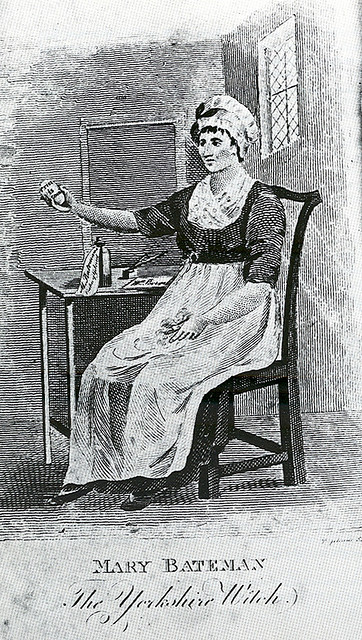
Mary Bateman's Skin

I located an article yesterday in an old issue of Country Life magazine relating to the remains of Mary Bateman, who, frequent readers may recall, was flayed after her body was displayed at the Leeds Medical School. I thought I would transcribe the article as, although it mostly repeats the well-known aspects of her life, it has some interesting facts I was previously unaware of including some details relating to the use of her skin to make various macabre trinkets.

MURDERERS' LEATHER By EDWARD ELMHIRST September 9th 1954


The last witch in Yorkshire, Mary Harker, who later became Mary Bateman, was born near Thirsk in 1768. According to the later accounts of her life, printed, wisely, after the events that had made her notorious, she soon gave evidence of a low cunning. She had what was then considered a good education for the daughter of an agricultural labourer, and went to school until she was 13; here she learnt to read and write, accomplishments she was later to use remorselessly against her more ignorant acquaintances. After a few years as a servant in Thirsk, she got employment making dresses in a shop in York, but she had to leave this post after her mistress had been robbed. She then moved to the new industrial Leeds and there set up as a rather inferior mantua-maker among the swarming factory workers.

When her business began to fail, she was happy to discover that she could supplement her income by telling fortunes. In 1792 she found another source of livelihood by marrying a wheelwright called John Bateman, a man both unlucky and unobservant. Next year a lodger lost two guineas, which were later found in the possession of Mary Bateman. No prosecution followed; "there can be little doubt," it was uncharitably recorded, "that the young man who she robbed made her infamy the price of his clemency." Her simple husband got a message calling him to his father's deathbed; but when he got there he was surprised and delighted to discover that the old man had never been healthier. When he got back to Leeds he was surprised again; Mary had stripped their house and sold everything that was movable.

In spite of this rather unsatisfactory married life, the Batemans again look up residence in the empty house, which Mary apologetically arranged to have refurnished as inexpensively as possible. This she did by the simple expedient of swindling local tradesmen. A new lodger was found - a bad choice on the part of Mary, who found him so insensitive and implacable that he actually made her refund money that he found her stealing. For this and other reasons the name of Bateman became locally so unpopular that her husband joined the Militia to get away from it all. Mary, not yet so confident enough in her abilities as a solo performer, trailed around the countryside in his wake.

After his demobilisation Mary entered into the second phase of her career. Her dilettante period of crime was over by 1798. For the next few years she found employment as a professional agent for a "screwer-down" a difficult art, needing explanation. Her victims were persuaded that some-body or other intended to do them evil, and that this potential evil-doer could only be prevented by "screwing down," which would stop them in their tracks. Mary did not claim to be able to exert this miraculous power of immobilisation herself, but she conceived of two phantom familiars, not like the two improbable little animals called Pye-wacket and Grizzel Greediguts, which had featured two centuries before in the witch-craft trials of Matthew Hopkins, but weighty and responsible ladies with respectable names. First was a Mrs. Moore, whose mere mouth-piece Mary claimed to be. Mrs. Moore was conjured up about 1799, and a man was enabled to have his creditors screwed-down by giving Mary money for the mythical Mrs. Moore . Mrs. Moore was also much employed as a screwer-down of husbands whose affections seemed liable to wander, and it was while acting for Mrs. Moore that Mary also started business as a part-time abortionist.

To be appreciated as an unofficial witch, Mary needed some widely recognised miracle. In Black Dog Yard in Leeds she announced that one of her hens had laid a phenomenal egg on which were clearly to be read the words CRIST IS COMING. The prophetic hen and its egg were then exhibited to anyone who cared to pay for the privilege. The mis-spelt and misbegotten egg achieved considerable local fame and Mary, by this time a skillful if unorthodox obstetrician, was able to stock the hen with other no less miraculous eggs for laying in the presence of witnesses. When the hen grew tired or resentful, it was sold to a neighbour who, finding no other mysterious messages vouchsafed, ate it in an unimaginative way.

Meanwhile Mrs. Moore, whose screwing-down had not been uniformly successful, gave place in 1803, without a protest, or perhaps with a simple metamorphosis, to the equally imaginary Miss Blythe, who could also rule destinies if suitably furnished with money. Two comparatively wealthy sisters were advised by Mary that their own futures and that of their business, a drapery, could be ensured by acting on the instructions of Miss Blythe. Miss Blythe sent a potion by the hands of Mary, which quickly eliminated one of the women. Another dose was needed for a curious mamma, and finally the other sister was poisoned a few days later.

Mary, though suspected, said that the plague had killed them all. Miss Blythe did not feature at the inquest, and, by the time Mary had been through the account-books, the dissolved drapery business could not pay its creditors more than eightpence to the pound.

This failure of the phantom Miss Blythe in no way made Mary Bateman desert her. After several minor jobs, Mary and Miss Blythe got together for the last time.

Rebecca Perrigo, living in Leeds, was much troubled with intestinal discomfort. Mary diagnosed this, not as indigestion, but as the effect of a curse which only Miss Blythe could counter. Mrs. Perrigo and her husband were convinced: thereafter this fatuous couple blindly obeyed letters of instruction handed to them by Mary, and alleged to be written in the hand of Miss Blythe herself.

In the following months a vast amount of goods and not a little money were extorted from the Perrigos. When they began to get restive, Miss Blythe advised them to eat some honey to which Mary would have added a mystic powder. This powder proved to be nothing more esoteric than corrosive sublimate, which killed Mrs. Perrigo very promptly and made her husband extremely ill. Their medical advisor a surgeon called Thomas Chorley, suspected poison, and very soon Mary Bateman was on trial for her life. Since she had a collection of arsenic pills in her house and was even carrying with her, at the time of her arrest, a bottle containing an unwholesome mixture of rum, oatmeal and arsenic, she made but a poor defence from the dock.

She was hanged at York, in company with another poisoner, on march 20, 1809. Her body was taken to the General Infirmary at Leeds where it was put on view at the charge of threepence a visitor, and no fewer than 2,000 people came to gape. It was afterwards dissected - this had been part of the sentence - and the greater part of her skin seems to have been tanned. Her skeleton, without the mandible but with an additional pair of ribs, remains in the Anatomy Department at Leeds Medical School.


Mr. Chorley, who had looked after the Perrigos and had analysed the brew that Mary carried with her, was also one of the dissectors at the Infirmary, and doubtless reserved various titbits for his friends. Among these was William Elmhirst, an eminently dull and upright Deputy Lieutenant for the West Riding. It seems improbable that so worthy a man would relish a portion of a murderess, but a folding cup made of Mary's skin certainly belonged to his son Robert, who possessed a certain appropriately sardonic humour. Other portions of Mary's skin were in existence, at least until the beginning of this century. Volumes bound in her leather were then in the library at Marlborough House; others were once in Methley Hall in Yorkshire; but recent search at both places has not discovered them.


Though Mary Bateman (executed 1809) seems to have been one of the earliest murderers to have her skin preserved, she was certainly not the last. Body-snatcher Burke (executed Edinburgh 1829) provided leather for a pocket-book, and Steptoe (Reading, c. 1810) furnished the raw material for a pair of gloves. Charles Smith (Newcastle, 1817) and William Corder (Bury st. 1817), the latter of whom achieved inexplicable notoriety for the very hum-drum murder at the Red Barn, both provided leather that was unfeelingly used to bind accounts of their respective trials. Johnson (Norwich, c. 1816) went to bind his namesake's great dictionary, and Kazia Westcomb (exeter, c. 1815) was used to cover Milton's Paradise Lost. Another edition of Milton was bound in Devon in the skin of George Cudmore (Exeter, 1830). Cudmore seems to have been one of the last to be tanned. In 1831 the practice was described as one that "cannot be too much reprobated: it engenders brutality, and has a tendency to make the most serious things objects of heartless sport or utter indifference."

Early in December 1945, a ripple of horror went round the civilised world at the revelations from the court-room at Nuremberg. There were there exhibited pieces of skin from a lampshade made of human parchment, and the judges heard authenticated tales of more household ornaments found in use in Buchenwald concentration camp, and of others made for the amiable wife of SS Standartenführer Koch.

To us in these islands, securely blanketed in our century of respectability, such happenings were horrible and incomprehensible. Yet in many libraries and elsewhere in our houses there remain similar relics, sometimes unrecognised, sometimes unrecognisable, to remind us that our great grandfathers were in no position to cast the first stone. They chose, it is true, the skins of the prosecuted guilty rather than those of the persecuted innocent, but there would seem to be little variation in the aesthetic standards involved.

~

It appears from this article that Edward Elmhirst had access to the skin cup when he wrote the article as it has a photo accompanying it which I haven't seen elsewhere and his name reveals that he was related to the family who originally owned it. I intend to discover if the family still owns the cup, if anyone has any information relating to the next of kin of Dr Edward Mars Elmhirst (who unfortunately died a few years after this article was printed) I would love to talk to them. It appears that Elmhirsts still own farm land  near their ancestral seat, Houndhill.  

Tuesday, 5 February 2013

Hartshead Church, the Walton Cross and Robin Hood's Grave

I always enjoy plotting walks on maps, connecting old monuments and interesting places, and the Kirklees area seems to have lots of curious things worth exploring. Phil wanted to test the Angelystor mobile app that he has been making recently in a churchyard with a yew, and I found a reference to the graveyard of St Peter's in Hartshead having a similar mythology to the Llangernyw recording angel on Kai Roberts' Lower Calder Legends blog.


The Walton cross is across the road from Second Avenue, Hightown, set a little way off the road on a footpath. It's nice to see monuments provided with suitable access and still set in the location it was intended to rather than relocated to a museum, especially when it is an object of such immense beauty like this one. I don't think I've seen a roadside cross with such intricate carvings round these parts, you see them fairly frequently around cornwall  but this is a rarity here. I also haven't seen a Saxon cross with this kind of Tree of Life design before.


 The WYAS dates it to the 10th or 11th C and says it would have been taller and brightly painted, making it a prominent landmark for miles around. Even in it's slightly depleted state it is lovely to see, and the socket at the top which, presumably, would have held the missing top part, was filled with rainwater like a little wart well and had a few coins deposited inside.


Following Windy Bank Lane down the hill, we turned at Ladywell Lane towards the church. I wish I'd done a bit more research before we came out because apparently the Lady Well is an ancient well in the vicinity of the church and is still visible under a hawthorn tree. One for a return trip I think. The church itself dates back to the Normans with it's carved chancel arch and doorway similar to Adel church, but most of the building is of a later date.


 The churchyard holds the remains of a yew tree, even in death there are beautiful, gnarled patterns and twists to it's shape. Local legend has it that Robin Hood cut his last arrow (which he fired from his death bed to mark where he should be buried) from this tree. 


The churchyard also has numerous 17th century gravestones, and some possibly earlier. One medieval slab resembles early drawings of Robin Hood's grave, the gravestone of which has been replaced several times.


Compared with Stukeley's drawing of the original slab, the stepped cross of this stone does bear some similarities:


Aside from RH there are lots of old and beautiful monuments, including some Spiritus carvings, a favorite funereal motif of mine. 


From the church we walked down Church Lane, continuing into the footpath through Hollin Wood off Hartshead Lane. The footpath continued through the fields towards the Nun Brook, and the ground seemed extraordinarily full of bits of broken pots and little broken bits of clay tobacco pipes. My guess is that a Victorian rubbish dump lies somewhere underneath, but perhaps there is some other explanation.


Once we reached Leeds Road we walked up towards Robin Hood's grave, I understand now that the site is on private land and access can be arranged, the whole Kirklees hall estate is in the process of being sold so it may be some time before permission can be sought. However in my experience, generally speaking, most landowners do not begrudge discrete and unobtrusive entrance on to their land.


It seems a shame that, although access to this site should have been made public long ago, the interference of numerous societies and individuals has halted the progress of such a move by the previous landowners. It stands to reason that even the most open minded individual would object to an ancient relic under their care being advertised as some kind of supernatural theme park on the internet and it is sad that this has prevented more people from visiting such an atmospheric place. Mistakes are made with the best intentions though, and the new owners will hopefully have a greater desire to share the history of the place.


The grave is situated high on the rise of a hill, tucked under a grove of yews near the edge of a strip of woodland.


One side of the monument is falling down, dragging the cage of ironwork with it (supposedly erected in the 19th C to prevent Navvies from chipping away the stone which they used as a cure for toothache). The grave inside consists of a small, low boulder and a memorial slab built into the side of the stonework.


Walking northwards along the ridge you can also find the remains of a shooting tower, built to resemble a roman tower but now an unrecognisable mass of ivy and crumbling stonework.


Here is a photo of it from 1910, it's slightly hard to believe that it's decayed so much!


Thursday, 31 January 2013

City of Troy

Reading Sig Lonegren's book on labyrinths today, he writes briefly about the city of troy labyrinth, near Brandsby in North Yorkshire, and notes a lack of 'feeling' to the location which he attributes to the fact that it is a 19th century replacement of an earlier labyrinth that was located nearby.


I have visited this particular labyrinth several times, this picture shows it the first time I saw it, in the snow after climbing up to the Castle Howard pyramid some years ago. The drive to the labyrinth was ridiculous, we could barely stay clinging to the road and you couldn't tell which part was road and which was field. We found it up a slippery hill eventually, on a verge between two tiny villages. We stayed as long as we could in thefreezing cold, partly because the glittering undulations on the snowy path of the labyrinth was unbearably pretty in the moonlight, and partly because we knew we had to drive back down the slippy hill to possible death. 

As I'm not a dowser I can't say if the labyrinth had given me any signs of being inauthentic but perhaps the pilgrimage to the site endowed it with some kind of myth that might not have previously been there had we chanced upon it by mistake. 

My second visit to Dalby was a few years later, all being opposite, around midsummer. I think turf labyrinths are intended to be visited in the summer months, for one it probably doesn't do them any good walking them when the grass is at it's low ebb. 


The labyrinth was much easier to get to, although still quite good at hiding on the side of the road. 


The game of troy being linked with Scandinavia in the information given at the site is interesting, I always liked the Scandinavian folklore of stone labyrinths being used to trap malevolent spirits before voyages, the sailors would run to the centre of a labyrinth and then jump out, leaving the spirit behind. The game of troy pictured on the Tragliatella wine-server seems to show one of the riders leaving the maze carrying a strange, wizened creature:


The strange creature riding out doesn't seem to be off-putting for the couples on the other side of the picture, so perhaps it isn't intended to be as hideous as it turned out. 

The thought that the authenticity of an ancient site comes with some kind of curse, a spirit that follows you home, is not unknown to me. At the very least, spending long periods of time in an ancient, inhabited cave meant I took home a number of gigantic cave spiders in my backpack. To be on the safe side, I suggest leaping from the centre of any labyrinth you walk, even Saffron Walden, to make sure nothing follows you home.


I'm always interested to see labyrinths put to use, this webpage shows the Whitewater Mesa labyrinth, walked on horseback.