Monday, 22 March 2010

The Chevin over Otley - Cups, Crags and Bulls

With the joy of almost completely mutually appreciative company we bore on high upon the Chevin. The wind up here is always high to a breathless degree, whipping spirits up despite the fact you nearly always seem to be walking against the blow. The cloud broke often to give us heady spring rays and the view over Otley was so perfectly presented you could pick out shop fronts, possibly the Prince tribute shop if you are in the right mood. We decided to firstly locate Knotties stone, the best known megalithic feature upon the chevin. The track east towards the quarry on suprise view leads alongside the Yorkgate road, just as you reach a point parallel with plantations of trees on both sides of the path you should see a fairly wide stone with a large carving on your left.


Knotties stone has a striking similarity to the Grey Stone at Harewood. The rings and four central cups with a channel drawn out over to the east of the rise of Almscliffe did seem to me to be a deliberate directive act.


Image from Rombolds Way by E.T. Cowling


I can imagine beltane fires being lit here, maybe on beacon house farm, and on the horizon at almscliffe crag and in turn from there north east at harewood. The stone itself was low and unmovable, heavily worn and warm from the sun. We all bowed in turn around it to take angled shots of the shallow grooves and marvelled at the view from the spot. I guess this would be called the 'common' cup and ring as it follows a similar pattern to many in the UK and certainly the majority of local petroglyphs, but I tried on the spot to find some kind of physical relevance to the locality. The classic question in regards to cup and rings, and therefore what you decide when on location what to look for, is undoubtably as to whether they are ornament or amulet, as probed by H. J. Dukinfield Astley in Cup-and Ring-Markings: Their Origin and Significance and many others since . My feeling (greatly influenced by the writings of Alexander Thom and Aubrey Burl) has been that they had a double use as tools to determine astronomical events which had a great significance to the religion of a people who depended upon planning their survival through winters, and also coming together at times of fertility such as May day. If Aubrey Burls interpretation of the evidence from funereal customs in the Rites of the Gods is accurate, the communication between local settlements in times of often dire need were vital for their survival. Therefore beacon points like Almscliffe, the Chevin and Harewood were too essential to the communities and these carvings could have some use in such customs, which I think probably explains the remote hilly locations a lot of cup and rings exist in.


Taking into account the physical design of the carving, four cups within a set of 5 concentric rings with a strong line drawn from the centre outwards pointing north east. I wanted to consider the ornamental possibilities of the stone, because although our prehistoric forebearers must have been extremely hardy, practical people in order to survive, the poetry and artistic slant that many megalithic remains possess is undeniable: just look at the carvings at Bryn Celli Du in Anglesey or Newgrange in Ireland, and the poetic acts discovered in funereal rites at places like the barrow at Aldro in the Yorkshire wolds where an arrow head was found deliberately broken and placed pointing directly at the smashed skull of a infant burial. I was interested by the ideas put forth by Gyrus on the dreamflesh blog that suggested the patterns found in rock carvings related to shamanic practices. The river Wharfe lies directly below snaking through the landscape quite spectacularly, truly Gyrus' Verbeia serpent goddess in form. The concept of visionary experiences at these points seems entirely feasible, the altitude definitely lends itself to altered mindscapes, the wind high on the hill creating a kind of roaring isolation of sound. I thought the sites of some carvings could bear comparison to the Taoist shrines atop Mount Tai, supposedly channeling some kind of inherent power from the mountain itself but also its location offering the solitude, peace and altered air pressure to achieve a certain state of mind. Dobrudden necropolis in nearby Baildon moor was also home to a beacon fire, is high up on the landscape and obviously had sacred significance to the people buried there, and again we can see heavy concentrations of cup and rings nearby. The vortex like circles on knotties stone could very well be symbolic of some act of visionary questing, the carving possibly traced in some act of ritual devotion as a labyrinth is. One cannot help but trace these circles on first inspection, it is a compulsion to follow the curve and spiral on its path.


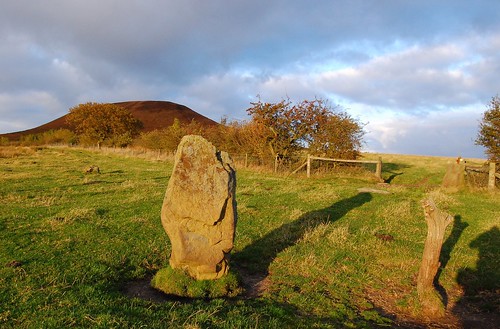
Southward we then headed down the footpath behind the Royalty pub. There was some slight confusion with directions but you can see the Bull stone from the pub if you look carefully from the added height of the style, and from there its just straight across two fields and hopefully avoiding whatever frisky cattle lays in wait that day. The Bull stone, so called because of a whetstone reference, a bull baiting past or a roman fertility remenant from the old road that runs along side it. Eitherway an impressive monolith, deeply weathered from a long upright stance. Just shy of six foot high and with a few possible companions hiding in the dry stone walls nearby. We hesitated to run across the field to meet the stone because of various animal guards, and as I walked up to the stone some horses were bucking alongside the fence a few feet away. The stone stands in private farmland so its probably better to skip along to the farm and ask permission, we didnt for our trip but in hindsight it seems polite with animals in the field. A mysterious stone, not on any of our OS maps but seems to be known locally at least. The rites of spring are often connected to the ancient Mithraic practice of sacrificing a bull, and it seems a strong coincidence to have the Mayday beacon gathering spot atop the chevin so convieniently positioned next to the bull stone, possible location of a bovine sacrifice. Also its interesting to consider that one of the more prominant stones in the Dobrudden necropolis has a carving which has been likened to the constallation of pleiades, which is in the zodiac sign of Taurus, the bull. These Beltane fires seem obvious meeting points at boundary lines between seperate communities where spring festivities and rituals could occur. Almscliffe, the Chevin and Dobrudden on Bailden moor all directly overlook ancient boundary lines, and Harewood, the Township Boundary.


we departed along the path of the roman road, realising that the stone was indeed visible from the road and looked much taller from this perspective than standing next to it. I was struck with the idea of arranging to light small fires at the Greystone, Almscliffe and Chevin on Beltane eve to see the effect.

Saturday, 6 February 2010

My shadow casts me


Last night I had a minah bird found in the fireplace, i held it slick and warm in my hands like august dreamy hot sticky hair. i cannot describe, the endless love, its spirit hopped and skipped through the air a thousand songs of joy to join the pretty clouds of steam that hung above the kitchen table. I dipped it in the water, soap bubbles flash oily rainbows and his feathers split to yellow under the surface, after the flapping wings spray water into the room. Shells catch his bright black eye and swirl down to inspect the fractured surface, a pearl spiral reflected inside, flashed on a retina i see exactly what you see, i feel what you feel i catch the warm air draft free and alone, starving and happy, my body doesnt feel this like you want it to. Then suddenly the jaws of a dog catch the black wing and crush its beautiful design, the perfect seperations twisted and torn, left alone on the floor. i cry for you and hold your broken body.

Monday, 18 January 2010

Seahenge, Internal landscapes of dreams, death and migraines.

Before I visit Seahenge, I want to properly explore how I understand it as a working portal to the underworld + death connected to the waking world by dreams and agony.


Seahenge is a Bronze age (contemporary to doll tor, main lifespan of stonehenge) monument, discovered at Holme in 1998, although local residents have suggested that various other seahenges appeared and dissapeared regularly along the shifting sands of the coast for many years prior to this. Francis Pryor thought that its place on the coast, situated in the Fens gave it a spiritual significance of bridging the gaps between the living world and the afterlife. Looking at the smashan burning grounds on the banks of the Ganges its easy to draw similarities between the two funereal practices, the reversal of the menstrual tide as the body and blood decay and are absorbed back into the Rainbow Serpent flowing of the seas and the rivers. Excarnation occurs, the bones are broken and the soul can be freed. Aubrey Burl theorizes in Rites of the Gods that the breaking of cremated bones, an act which appears to have been common throughout the UK's neolithic burial sites, was seen to free the soul, although skulls and jaw bones were often kept as totems for ritual use, or placed in mortuary houses to preserve the power of a communitys ancestors. Trephination similarly can be seen as a way to release the demons/spirits causing pain in the head, and the breaking of the bone releases the pressure and the demon. Evidence of trepanning goes back 40,000 years in human civilisation, an example from the Thames, near Hammersmith shows a hole in the head, seemingly deliberate in shape and with five years worth of regrowth of bone. The skull is between 3 and 5 thousand years old, a similar time frame to stonehenge and seahenge. The use of trepanning as a migraine relief mechanism makes sense to the sufferer, a release of pressure.


The migraine trance I have found myself in often leads to an internal exploration of the ability to transcend physical boundaries, in the many hours spent lying alone in bed, unable to sleep or move because of the pain you need to become adjusted to the sensation, otherwise it can be hard to keep a hold of your self. In disconnecting with the pain through trancework I have found it possible to find within it useful techniques and easier ways to achieve that state of mind. Entoptic visions are a nuisance in a public situation, but within a controlled state can bring one closer to visionary experiences. The visuals could be likened to descriptions of psychoactive drugs, geometric shapes and colours, flashes lights and strange auras. I've been told on several occasions that when ill, I lie with my eyes open but unconscious of whats going on around me, I contemplate nothing, pain becomes a distant echo. It sounds like a melodramatic statement, but many times I have felt rising panic at the situation, the unbearable pain and pressure feels like it must give way to some catastrophic internal event and death will soon follow. Cluster headaches have often sent me falling to the ground, seized by some terrible force that seems certain to kill me, or drive me to kill myself with the crushing agony of it. The connection between migraines and death, the trance-like existance of the migraine sufferer seems obvious to me, it binds you to follow a cycle of rebirth, feeling estatic at the pureness of becoming pain-free again, giddy and alive after days of isolation, darkness and complete introversion. The migraine dream, where the onset occurs before you wake, are always of death, and dying. The pain crushes you and you feel the slow inevitability of dying, or being dead and knowing no end to the paralysed pain. Through controlling your breathing, the pain does not nessesarily go away, but you move away from it. The state of mind you have control over does not need to correspond directly to the physical complaints of your body. The only unfortunate effect of becoming disconnected from the pain is that you no longer struggle to keep the pain under control, I have gone whole days without drinking or attempting to eat, or take painkillers which ultimately will prolong the migraine. The life of a migraine sufferer is often interspersed with these long contemplative times when they can do little else but think of their pain, I think it helps to try and use it productively if possible.

Seahenge is now preserved in wax and on display at Kings Lynn museum.


this is 'Applehenge', the replica constructed for the Time Team programme on the excavation of Seahenge. There was some controversy surrounding this structure, due to the fact no planning permission was obtained for it to be built, and the Oak used for the centre was a protected tree. Its location in an orchard in Norfolk is now unadvertised and very low-key, presumably due to these problems.


Despite the issues with Applehenge, I couldn't help but feel the value of reconstructing the monument in full size. The aging of the timbers since the programme was aired, with Ivy curling up the centre tree, gave it a somber air of beauty. It is very easy to imagine the place bedecked with funereal adornments, lone yggdrasil in the marshes with a rain-washed figure prostrate on the upturned roots.


Thursday, 14 January 2010

Windy Hill - M62 mythology and saddleworth moor


Scammonden Bridge with its huge cutting looms over the road skeletal, back arched and punctuated with ribs of concrete, it's vast irregularity unnerves. Saddleworth moor is just beyond and, reinforced with repetition, reminds me of the many car journeys, the points along the way at which my Mother would tell me the same stories along the way. The sign bluntly points out that this is the highest motorway in england. 1442ft above sea level,
there seems to be a silent mark of the ascent a few moments before as simultaniously, everyones ears pop at the change of air pressure.

saddleworth moor, where they buried those kids, creeps along beside you. Its not a pretty moor, it looks cold and empty, like a house derelict before its been lived in. The sky meets the ground in a hazy confusion, the road splits to allow for stott hall farm, the sheep look grubby, small and too natural next to the endless stream of mechanical speed, mud is pasted on their wool, the farmhouse, the concrete underpass.

My mind feels the burden of dozens of imprints of this journey, the same words spoken at the same points along the way. I have begun to see, at the pennine way overpass and as the huge cathedral cutting of scmmonden bridge towers above, a naked human corpse, bloated and blue stood upright in the road ahead. My mother's edema ridden body remembered from a hospital bed appears to me, preserved on a road that has formed me. Countless journeys along here, every one either with her, telling me the same mythologies as if i'd never heard them before, or without her and knowing when she'd say it. It is a chemical tic I can't shake, it will live with me forever, her morbid curiosity in the lost childrens' graves now haunts it. Dont dally, think of Lesley-Ann, buried with her plastic beads further down the valley at Hollin brown knoll, her features were preserved by the peat like Tollund Man. As Yorkshire turns to Lancashire, the road becomes lost in thought.


Tuesday, 12 January 2010

The Godstone


The Godstone is a small, christianised monument in a churchyard in Formby, north of Liverpool. It supposedly used to reside in the village green but was moved to its position in the churchyard, and inscribed with a cross, and steps to symbolise the ascent to heaven.


"Until recently Roman Catholics were buried here, and the coffins carried three times round this stone, presumably (as in other instances) following the way of the sun. The custom may be very ancient, and indeed a pagan survival. Roman Catholics, moreover, in visiting the churchyard, used to kneel down and pray before this stone."


We couldnt find it for a good while, we looked all around the church, and into the trees further back but eventually after splitting up to curb the boundarys found it to the west of the church at the furthest point of the churchyard there. It was smaller than we expected, but very sweet and joined by a few other similar sized boulders. The carving was unusual, an abstract sigil rather than a stern reminder that, as it has been said to describe this rock;

•" where God hath a Temple, the Divell will have a
chapiiel: where God hath sacrifices, the Divell will
have his oblations."

We were dusted with snow as we took our photo, and then the skies grew heavy with it. The car got fairly stuck and we foolishly meandered back towards the sea to find Gormley's Another Place. The drive back across the pennines was sickeningly slow, slippy and tiring.


Doll Tor stone circle, Birchover in the Peak District


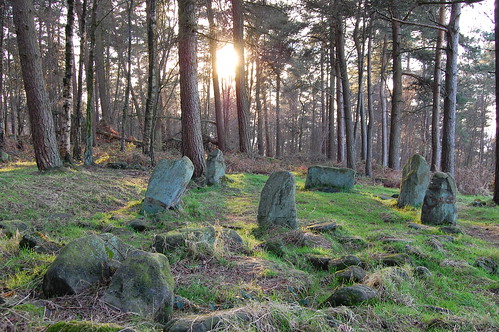
Doll Tor, a minature bronze age beauty tucked away a little south of the better signposted Nine Ladies stone circle, north east of the ruined stone circle Nine Stones Close. A small cairn lies next to it, which seems to be slightly rearranged every time we visit. The cairn contained a cist which held a cremated female burial.

This bead found at the circle during an early excavation is thought to be from egypt, from around 1300 BC.

The circle was vandalised during the spring of 1995 and reconstructed in 1997 by a team of archaeologists, restoring it to bronze age condition. The photo in Julian Cope's Modern Antiquarian shows it meddled with,


. During a Heathcote excavation in the 1930s three of the stones were mysteriously smashed overnight, you can see the (deteriorated) cement joins holding them together.
The relatively modern woodlands surrounding the stones give it an atmosphere of calm and solitude that is missing from its companion Nine Ladies. I try to picture the place alone atop a moor as it must have been every time we visit and fail, I take solace in the fact that, tucked to the side of the proto-temple of the andle stone, its location always bore it more to the shelter of its landscape than to crown it. The quarry a few feet north of the stones is shockingly close, and gives me quiet horrors as to what could have been the fate of this place. I presume the local interest in archaeology borne of Thomas Bateman who lived in Birchover and excavated this site in 1852 saved it from certain doom.


You can look across from the edge of the woods by the circle to Robin Hoods Stride, and easily walk it should you wish to, I imagine with the trees clear you could view Doll Tor from Nine Stones Close and vice versa. We've seen many offerings and ribbon on the trees, but haven't once chanced upon any other visitors at any point, and we come here often. Halloween was particularly special, we put a lamp in the middle of the circle, the boys climbed the Andle stone in the dark (the girls + jeff sensibly abstained) and the stars were bright in the sky. We do sort of think of this place as ours, as I'm sure many other people do!


We found a fallen tree, with some rocks beneath its roots just beyond the cairn. There were some carvings on it, possibly a figure and an ear of corn.


Howden Hill & Blakey topping - North Yorkshire


The hill borders the RAF perimeter fence and access down to it passes an old associated airfield. The old monuments to life and death stand eye to eye with modern ones. I think the moors have not lost their discourse in the wilderness as planted there by our ancestors. They seem to echo a past from which we have barely evolved. The monoliths and carvings on the rocks may have been a navigational and astronomical aid for nomadic tribes or lone wanderers survive the harsh, confusing conditions on the moorland. Fygela as it was known was a fairly inhospitable place but the dangerous nature of the location itself seems to have imbued it with a spiritual significance to the neolithic population, with many burial howes and cairns remaining to seek a path through what could easily be deadly.

The moorland megalithic sites helped turn the qliphothic moorland into an inhabitable place, to create a balance within a seafaring community whose heart lay out to sea. These monuments now centre around a different danger, the eyes and ears of which look across the world and into the stars. The pyramid on fylindales moor claimed to be the voice of God during the cold war, giving us the three minutes to prove our worth before we faced whatever lies beyond. Talismanic, it promised to exact an eye for an eye on those who wished to destroy us, and protected us with the same terrible power we ourselves feared.