Showing posts with label bronze age. Show all posts

Friday, 16 November 2012

Llangernyw Yew, Gwytherin and Gwrych


Llangernyw yew is the oldest tree in Wales, and one of the oldest living things on Earth. I was lucky enough to hitch a ride there last week and check out this beautiful tree first hand.


Local legend holds that Angelystor, the recording angel, manifests inside this 4,000 year old tree and appears on Samhain to solemnly intone the names of those who will die in the coming year. Most of the people who I mentioned this to in relation to my impending visit seemed to genuinely suspend disbelief in response to the tale and asked me to tell them if the spirit mentioned their name. I was impressed at the power of the myth before I even visited the place.


We arrived at Llangernyw at 11pm, as we imagined the churchyard would be best experienced late at night.There wasn't much time then as we had an early start, but being abruptly left on my own as my companion left me to photograph the tree while he had a smoke with the creak of the ancient branches of the yew in a slight breeze, was one of the most genuinely awe-inspiring moments spent in it's company.


The quiet of the country night is a very special thing and I miss it more with each passing day. To be able to escape the constant drone of mechanised life, to be able to hear the sounds of a natural world, these things are very rare now. The yew spoke in it's low creaks, a ship on an undulating ocean, moving softly it's fine needles to slice out ogham letters in the air.


A comfortable night was spent at Plas y Brenin, and I was back at Llangernyw first thing in the morning. No longer did the dark green canopy merge with the stars but the yew was illuminated in beautiful morning sunlight, a rare warm November day.


 I felt humbled in the presence of this most ancient, beautiful and very much living thing, having sought out old trees before. The Laund oak near Bolton Abbey is gnarled and skeletal, only a few remaining branches pushing out green breaths of leaves. Old trees are usually impressive in their near decimation, their struggle against the canker that will inevitably kill them creating hollow depths to explore in their Ent-like trunks, precariously leaning knotted arthritic branches bowing in to the ground and bare, exposed barkless twig fingers littering the ground.


The Llangernyw yew is a different kind of creature, lithe and green, the dark branches spreading-wide in graceful arches. A male yew, it's branches were full of the little green cones which spread it's seed, I collected some of the bright plump berries from the female yew which grew a couple of yards away to grow a tiny Llangernyw yew of my own.


On the other side of the church, two standing stones around a recumbent create a cove to stand, a foresight from some bronze age observation. The old churchyard is roughly round, elevated from the surrounding village as though built on a mound. One of the stones bear an old inscribed cross, allowing it to remain an obviously pagan symbol in a Christianised site.


A four mile walk over the hill from Llangernyw is the tiny village of Gwtherin, which has it's own trio of ancient yews in St. Winifred's churchyard. A row of four standing stones runs inbetween the line of the stream and the church, one inscribed with "VINNEMAGLI FILI / SENEMAGLI", this inscription is dated the the 5th century but the stones seem earlier.


On the drive home, I paid a return visit to Gwrych Castle over Abergele, which enchanted me and Briony in the mist several years ago.


The castle remains as a Gothic shell, built in 1819 on the site of a hillfort but left to decay in the 1980s. Having only explored the exterior before, the interior was a slightly terrifying experience, a precarious mess of missing floors and crumbling walls, the most impressive remaining feature being the huge marble staircase.


I have to admit to being a little skeptical of the recent ghost photography at Gwrych, the most frightening aspect of the building being the very un-supernatural potential for large pieces of stonework to crush you to death, but it is a special place - possibly somewhere that should be maintained as a spectacular ruin rather than modernised into a hotel.

Tuesday, 7 February 2012

Standing Stones Rigg - Dalby Forest


Snow defines things so perfectly that it seems to stop time. 
My partner's daughter once said that "snow was quiet like a skull"


.

Friday, 23 December 2011

West Kennett


A contrast to the wind and rain-lashed stones down the hill at Avebury, West Kennett long barrow was tangibly warm, quiet and calm. The hill it lies upon looks over the pregnant belly of Silbury Hill across to windmill hill with its neolithic enclosure and perfect bell barrows. I felt the slight unease of entering chambers already inhabited, the dark spaces to the north and south seemingly full of unseen figures, but the overwhelming calm of the place is beautiful especially set against the extremes of midwinter weather. We reached the tomb at midday although the skies seemed to be darkening already.


It brought back instantly the experience of stumbling along a cliff side to reach Barclodiad y Gawres in Anglesey in a torrential rain storm, each step a struggle until we reached the entrance and became muffled from the howling of the wind, safe from the rain, warm and safe with the ancestors. The positions of both passage graves seems designed to amplify the womb-like effect of climbing back into the earth, the uphill struggle we all face before death washes over us.


We had formed vowel chants (along with two of our dearest friends, S+S) with magical intent in preparation for a performance at the John Hansard gallery in Southampton some days prior to our visit to Avebury. The few consonants included invoked the gods of places sacred to us, although our dedication placed them a long way from their respective shrines.


Xenis Emputae Travelling Band - West Kennet Long Barrow Vocal Improv by larkfall

The echoing acoustics of the artificial cave, along with the low quality of my smartphone recording make this a very rough listen!


Monday, 18 July 2011

Stanton Moor


Frosty mornings in Birchover.


Nine Ladies Stone Circle


Doll Tor


God's Eye


Elaborate rock carvings at Rowter Rocks.


The Mock Beggar's Hall, standing astride the ancient Limestone way.


The view from Robin Hood's Stride, across the beautiful Wye Valley.


Nine Stones Close, now just four.

Monday, 18 January 2010

Seahenge, Internal landscapes of dreams, death and migraines.

Before I visit Seahenge, I want to properly explore how I understand it as a working portal to the underworld + death connected to the waking world by dreams and agony.


Seahenge is a Bronze age (contemporary to doll tor, main lifespan of stonehenge) monument, discovered at Holme in 1998, although local residents have suggested that various other seahenges appeared and dissapeared regularly along the shifting sands of the coast for many years prior to this. Francis Pryor thought that its place on the coast, situated in the Fens gave it a spiritual significance of bridging the gaps between the living world and the afterlife. Looking at the smashan burning grounds on the banks of the Ganges its easy to draw similarities between the two funereal practices, the reversal of the menstrual tide as the body and blood decay and are absorbed back into the Rainbow Serpent flowing of the seas and the rivers. Excarnation occurs, the bones are broken and the soul can be freed. Aubrey Burl theorizes in Rites of the Gods that the breaking of cremated bones, an act which appears to have been common throughout the UK's neolithic burial sites, was seen to free the soul, although skulls and jaw bones were often kept as totems for ritual use, or placed in mortuary houses to preserve the power of a communitys ancestors. Trephination similarly can be seen as a way to release the demons/spirits causing pain in the head, and the breaking of the bone releases the pressure and the demon. Evidence of trepanning goes back 40,000 years in human civilisation, an example from the Thames, near Hammersmith shows a hole in the head, seemingly deliberate in shape and with five years worth of regrowth of bone. The skull is between 3 and 5 thousand years old, a similar time frame to stonehenge and seahenge. The use of trepanning as a migraine relief mechanism makes sense to the sufferer, a release of pressure.


The migraine trance I have found myself in often leads to an internal exploration of the ability to transcend physical boundaries, in the many hours spent lying alone in bed, unable to sleep or move because of the pain you need to become adjusted to the sensation, otherwise it can be hard to keep a hold of your self. In disconnecting with the pain through trancework I have found it possible to find within it useful techniques and easier ways to achieve that state of mind. Entoptic visions are a nuisance in a public situation, but within a controlled state can bring one closer to visionary experiences. The visuals could be likened to descriptions of psychoactive drugs, geometric shapes and colours, flashes lights and strange auras. I've been told on several occasions that when ill, I lie with my eyes open but unconscious of whats going on around me, I contemplate nothing, pain becomes a distant echo. It sounds like a melodramatic statement, but many times I have felt rising panic at the situation, the unbearable pain and pressure feels like it must give way to some catastrophic internal event and death will soon follow. Cluster headaches have often sent me falling to the ground, seized by some terrible force that seems certain to kill me, or drive me to kill myself with the crushing agony of it. The connection between migraines and death, the trance-like existance of the migraine sufferer seems obvious to me, it binds you to follow a cycle of rebirth, feeling estatic at the pureness of becoming pain-free again, giddy and alive after days of isolation, darkness and complete introversion. The migraine dream, where the onset occurs before you wake, are always of death, and dying. The pain crushes you and you feel the slow inevitability of dying, or being dead and knowing no end to the paralysed pain. Through controlling your breathing, the pain does not nessesarily go away, but you move away from it. The state of mind you have control over does not need to correspond directly to the physical complaints of your body. The only unfortunate effect of becoming disconnected from the pain is that you no longer struggle to keep the pain under control, I have gone whole days without drinking or attempting to eat, or take painkillers which ultimately will prolong the migraine. The life of a migraine sufferer is often interspersed with these long contemplative times when they can do little else but think of their pain, I think it helps to try and use it productively if possible.

Seahenge is now preserved in wax and on display at Kings Lynn museum.


this is 'Applehenge', the replica constructed for the Time Team programme on the excavation of Seahenge. There was some controversy surrounding this structure, due to the fact no planning permission was obtained for it to be built, and the Oak used for the centre was a protected tree. Its location in an orchard in Norfolk is now unadvertised and very low-key, presumably due to these problems.


Despite the issues with Applehenge, I couldn't help but feel the value of reconstructing the monument in full size. The aging of the timbers since the programme was aired, with Ivy curling up the centre tree, gave it a somber air of beauty. It is very easy to imagine the place bedecked with funereal adornments, lone yggdrasil in the marshes with a rain-washed figure prostrate on the upturned roots.


Tuesday, 12 January 2010

Doll Tor stone circle, Birchover in the Peak District


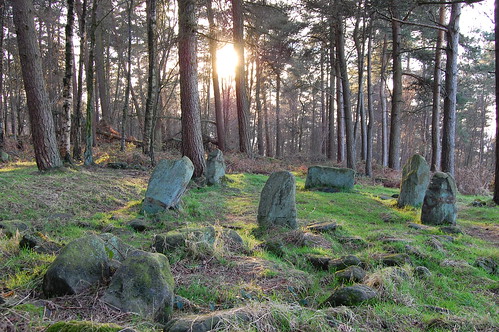
Doll Tor, a minature bronze age beauty tucked away a little south of the better signposted Nine Ladies stone circle, north east of the ruined stone circle Nine Stones Close. A small cairn lies next to it, which seems to be slightly rearranged every time we visit. The cairn contained a cist which held a cremated female burial.

This bead found at the circle during an early excavation is thought to be from egypt, from around 1300 BC.

The circle was vandalised during the spring of 1995 and reconstructed in 1997 by a team of archaeologists, restoring it to bronze age condition. The photo in Julian Cope's Modern Antiquarian shows it meddled with,


. During a Heathcote excavation in the 1930s three of the stones were mysteriously smashed overnight, you can see the (deteriorated) cement joins holding them together.
The relatively modern woodlands surrounding the stones give it an atmosphere of calm and solitude that is missing from its companion Nine Ladies. I try to picture the place alone atop a moor as it must have been every time we visit and fail, I take solace in the fact that, tucked to the side of the proto-temple of the andle stone, its location always bore it more to the shelter of its landscape than to crown it. The quarry a few feet north of the stones is shockingly close, and gives me quiet horrors as to what could have been the fate of this place. I presume the local interest in archaeology borne of Thomas Bateman who lived in Birchover and excavated this site in 1852 saved it from certain doom.


You can look across from the edge of the woods by the circle to Robin Hoods Stride, and easily walk it should you wish to, I imagine with the trees clear you could view Doll Tor from Nine Stones Close and vice versa. We've seen many offerings and ribbon on the trees, but haven't once chanced upon any other visitors at any point, and we come here often. Halloween was particularly special, we put a lamp in the middle of the circle, the boys climbed the Andle stone in the dark (the girls + jeff sensibly abstained) and the stars were bright in the sky. We do sort of think of this place as ours, as I'm sure many other people do!


We found a fallen tree, with some rocks beneath its roots just beyond the cairn. There were some carvings on it, possibly a figure and an ear of corn.